Based on the article, here’s a 3-4 sentence summary:
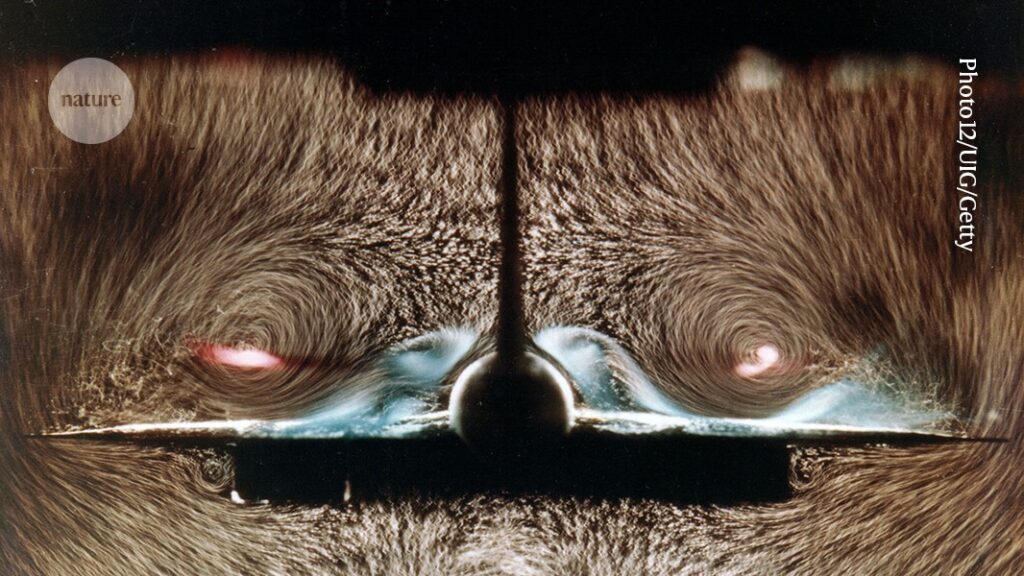
OpenAI recently claimed its AI model solved a famous Millennium Prize Problem by proving that the Navier-Stokes equations—which describe fluid flow—can produce “singularities” predicting physically impossible infinite speeds. The singularity occurs when a fluid vortex becomes extremely thin (around 70 nanometers for air), at which point the equations’ assumption that fluid is continuous rather than made of individual molecules breaks down. While the Navier-Stokes equations were already known to fail under certain conditions like rarefied gases and compressible fluids, researchers continue using alternative approaches such as the Boltzmann equation or molecular simulations to model fluids at different scales. The finding raises questions about AI’s mathematical capabilities, attribution of research, and what alternative methods are needed to accurately understand turbulence and fluid dynamics.
Up Next
Latest
-
AI cracked the Navier–Stokes challenge. What does that mean for physics? | Nature
-
US troops must be ready for space combat around moon, Trump’s top military adviser says | The Independent
-
US acknowledges for the first time that it has deployed weapons in space
-
Mysterious object spotted in NASA moon photo sparks theories of extraterrestrial life: '100% proof' | Daily Mail Online